“Don’t it always seems to go/You don’t know what you’ve got till its gone.” – Joni Mitchell
Terry McGarity and his wife Josephine, both born in 1946, are an Irish-Italian couple from refugee families who found freedom and prosperity in Australia.
Terry started his sporting career with Braybrook under tens in the mid ’50’s.
He coached successfully in three sports:
2 Stawell Gift winners.
Football and cricket premierships for Spotswood. (But for Terry, as for me, the greatest premiership ever is the Western Bulldogs astonishing triumph in 2016.)
Terry coached three years of finals appearances with Footscray under 19s.
He coached his son Beau to victory in the 3200 metres at Stawell.
In 2025, Beau’s son Liam is fullback for Braybrook.
Back where it all started
Family and tradition are the glue that make freedom possible.
Sport protects these values.
Thats why Australia needs true sport more than ever.
Robert Herbert Skilton (a.k.a. Bobby Skilton senior) played 150 games in nine seasons at Port Melbourne Football Club (PMFC) and in 1929 became captain of Port 3 games into his final season at the club.
He lead the local player dominated Borughs (a.k.a. Port Melbourne) to second place against a much richer, more physical Northcote line-up with bigger, stronger, more experienced Ayers. Port set their hopes on winning with youth and pace
The Argus newspaper wrote that “many cowardly kicks and punches were exchanged in the course of a disagreeable game.” The Age reported that “there were some spiteful exchanges as Northcote’s tactics wore Port down.”
PMFC historian Terry Keenan writes in his book “Unduly Rough Play” that the Boroughs held the view “that Northcote’s tactics were ‘very questionable’ and did ‘everything it is possible to do on a football field. Any Port player doing well became a maked man.” (p 80)
Perhaps his time at Port Melbourne gave Bobby Skilton Snr the toughness he needed to survive the Burma Railway.
His son Bobby Skilton junior is a triple Brownlow medallist and AFL legend.
Terry Keenan writes that Skilton senior was “a model clubman as well as an excellent player being secretary of the social club for a number of years and a leading light at club social activities because of his musical talents.” (p 83 Unduly Rough Play)
I see some parallels between the two Bobby Skiltons and the two Ron Barassis. Ron senior was a premiership player who died in 1941 at the siege of Tobruk.
Perhaps future Port versus Casey Demons games could be for a Skilton-Barassi Cup.
Lest We Forget those who went before us and fought against tyranny.
For me women’s footy is way better to look at than the men’s game.
Just look at the teamwork, skill, strength and joy in this passage of play from last Saturday’s Spurs-Eagles clash at the Merv Hughes Oval in beautiful parkland on the banks of the Maribyrnong River:
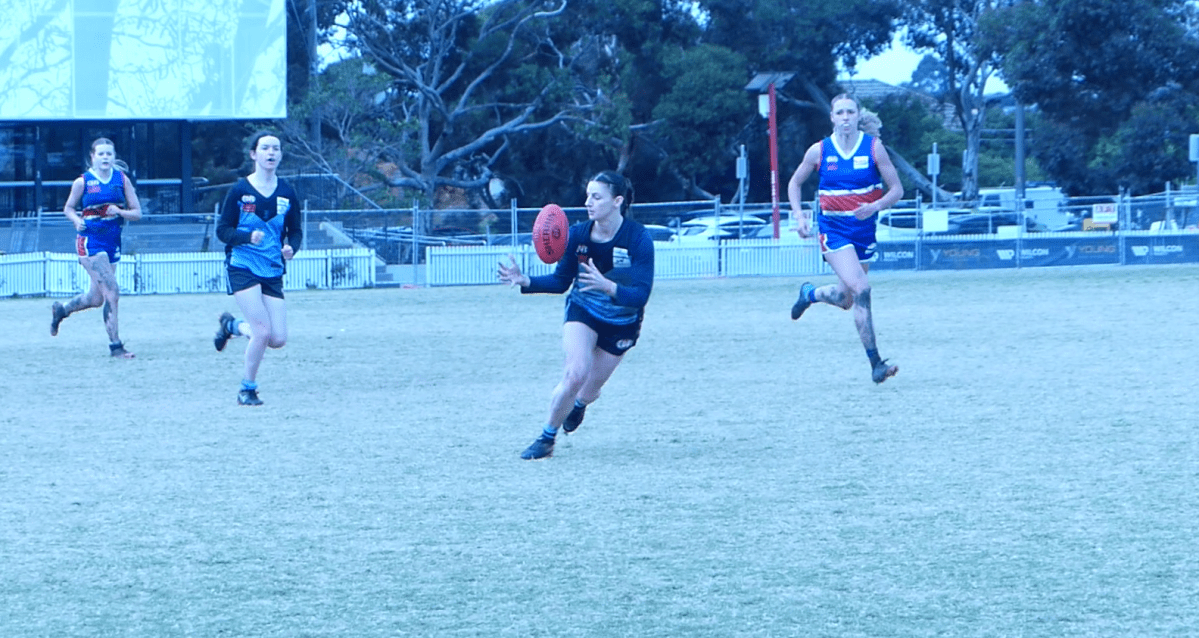
A great chaos ball into the forward pocket from Parkside Spurs number 26 leads to winger no 4 leaving her Yarraville Seddon opponent flat footed to kick a goal.
It provides a better spectacle and healthier community than the men’s game.
Watch the strength, agility and quick thinking of number 22 from Aberfeldie as an example of how good the women’s game can be to watch:
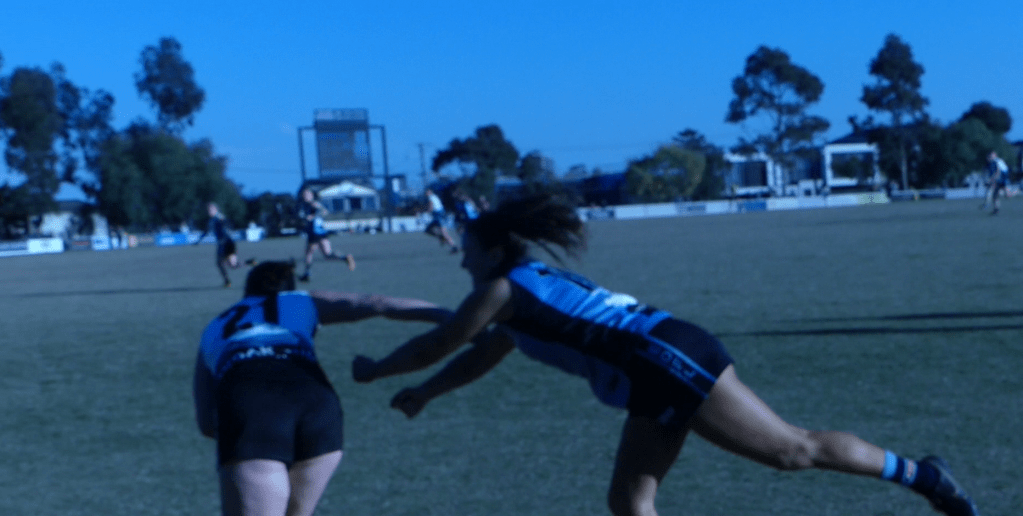
With a fantastic tackle she dispossesses a powerfully built Hillside opponent of the football, and then gets to her feet and brilliantly anticipates the trajectory of a handpass from another Hillside player to knock the ball behind an opponent and run around that player to gain possession for her team and race off to send the ball goalwards before anyone could stop her.
What an incredible bit of multi-tasking in congested play.
Yesterday, I had the enormous privilege to witness the three quarter time huddle of the Hillside women’s senior football team in a match against Aberfeldie.
Hillside had gone into the match undefeated and Aberfeldie were second on the ladder with two losses. At halftime it was a point the difference but Aberfeldie completely outclassed Hillside in the third quarter to go five goals ahead.
The determination of Hillside to fight back reflected in the fierce raw of their voices in that huddle was the most passionate sound I have ever heard from a group of footballers.
Previously it has been my contention that women’s footy is not as ferocious as men’s footy.
I stand corrected Hillside.
You dominated the first half of the final quarter.
With raw passion you clawed back two goals of the deficit.
Then this incident might have taken the wind put of your sails:
Perhaps if female football had more field umpires (the state government has recently cut back funding to female football), such violence would not effect the result of a game as I believe might be the case here.
I may be wrong. Aberfeldie is a very good side. They played well.
Also, I am not a psychic. I do not know if the violence was intentional or accidental. But I was standing a few meters away and the distress of the Hillside woman, who collapsed crying to the fetal position was so severe that I consciously made the decision not to film it, feeling in my gut that filming it would have invaded the hurt player’s personal space. 30 years of being a Registered Midwife has taught me that sometimes, no matter how much you might want to help, you have to let the woman do what she needs to do on her own.
That type of passion, of agony (cf Jesus on the cross), is a result of being a ball winner and a ball carrier and liable to be hit in a robust contact sport.
Here are some more examples of wonderful passion for the contest from the Hillside senior women.
Up forward Patty (spelling?) can crash through the packs to mark the ball in ways that remind me of the power of Travis Cloke.
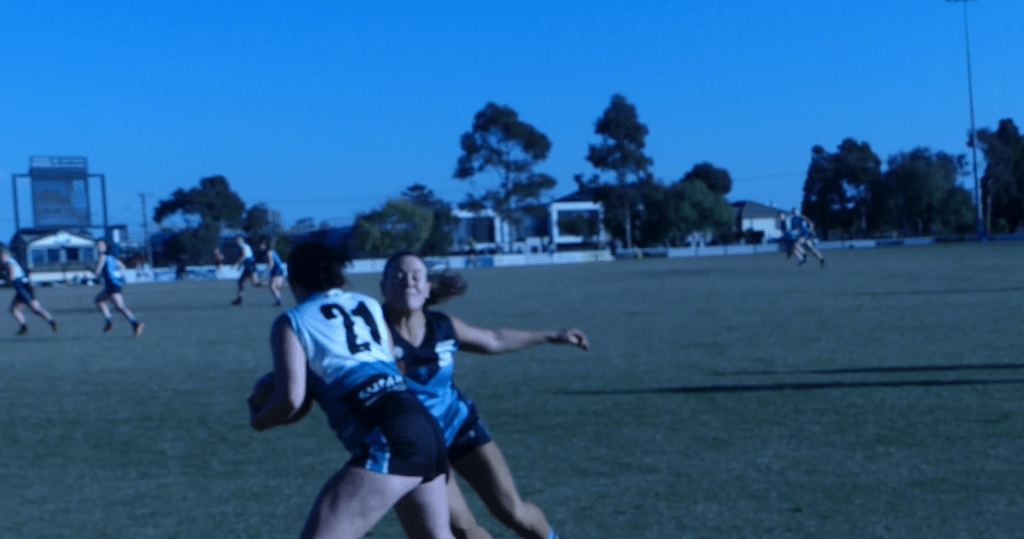
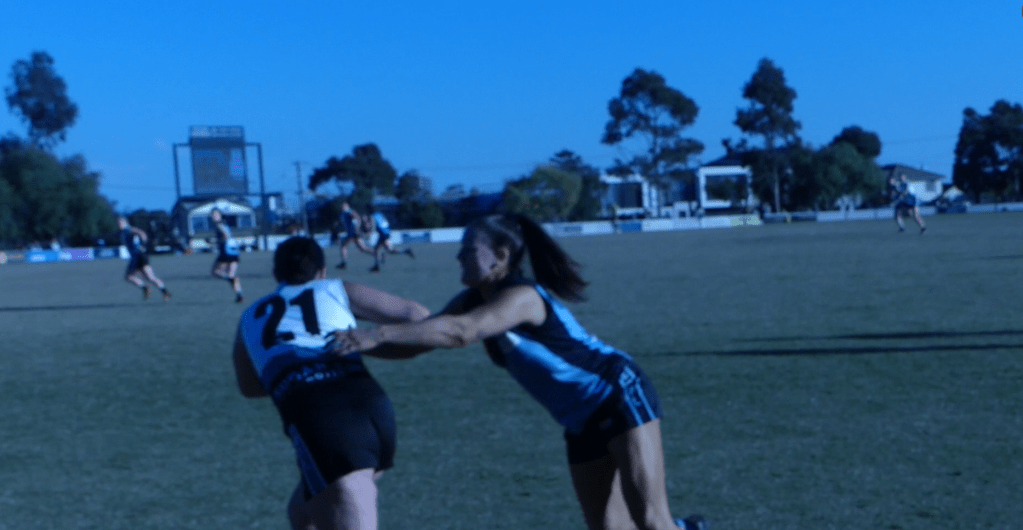
Hillside player number 21 gets around an Aberfeldie players attempt to tackle with strength and peace:
I am not sure if the above is “selling candy” (fooling a chasing player by pretending to move one way and than going the other way) or a “don’t argue” (fending off a tackling player with pure strength) or both or neither. But I think the beautiful poetry in motion of these woman is great to savor in stills.
True athleticism is always beautiful.
Hillside and Aberfeldie will meet again this year and in my eyes are favorites to play in the grand final for this year’s premiership. What a prospect.
The best thing about being in Melbourne, Australia, is watching the free flowing glories of Australian Rules football in the state where the game was born.
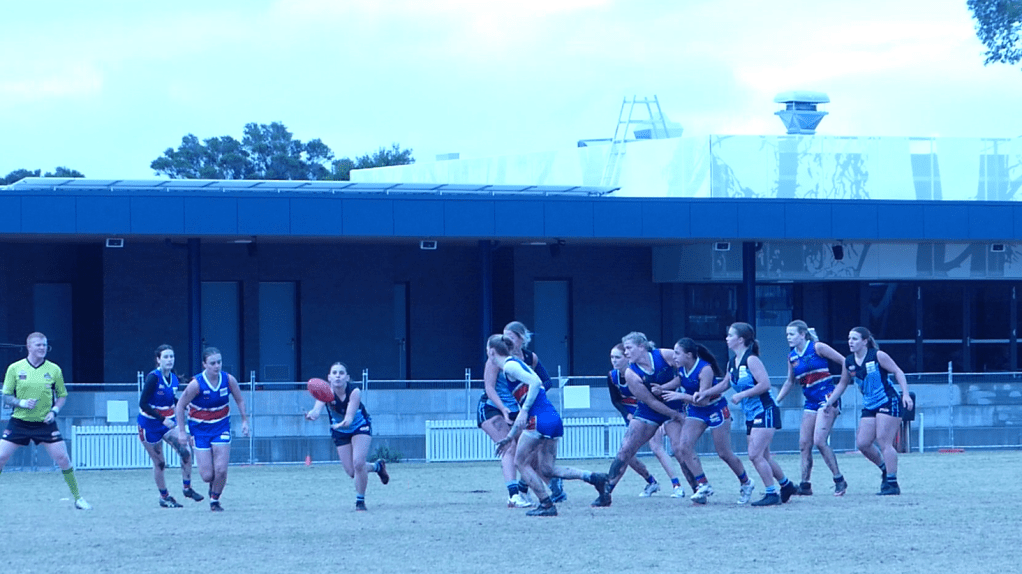
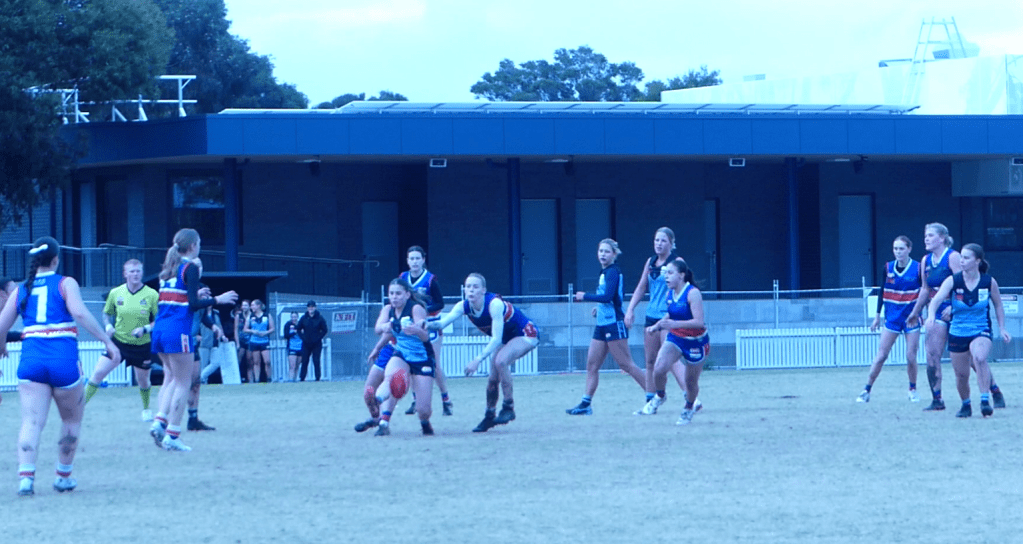
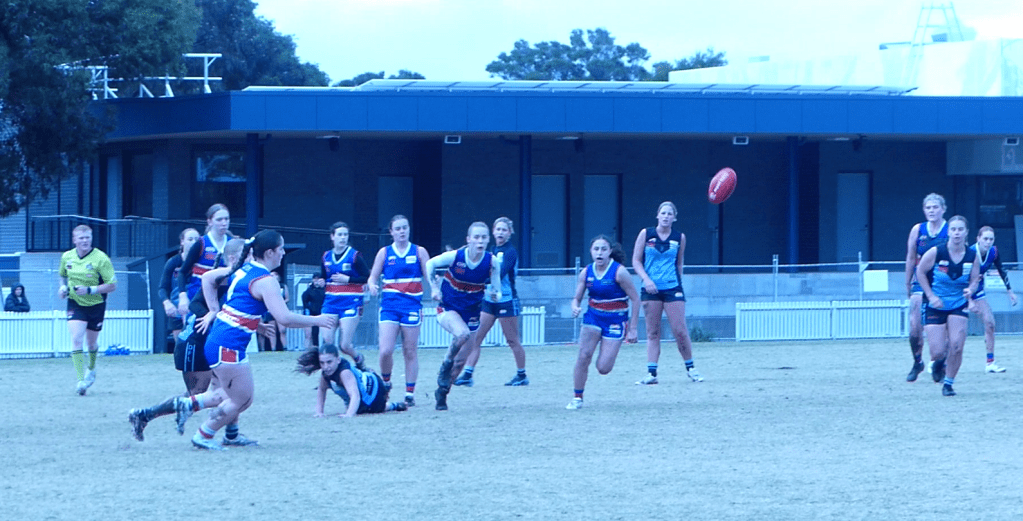
This clip is from an Australian Rules football game yesterday between Aberfeldie who wear dark shorts and have light blue on their jumpers. Their opponents Keilor wear bright blue shorts and have red and white bands on their bright blue jumpers.
A Keilor player won the hitout in the ruck contest, but an Aberfeldie player showed better anticipation and quicker reaction than her opponents to win the ball.
She very skillfully and accurately executes a kick called a drop punt to her teammate. A drop punt is a kick that spins end over end and therefore usually travels in a straight line when hitting the ground.
The ball’s next recipient made no mistakes in retaining possession for her team.
She promptly handpassed to a teammate in a much better position to kick it down field.
While on the run, the new ball carrier took her time to look for the best option downfield.
She made sure that the carefully considered kick cleared the hand of a Keilor player attempting to smother.
The kick arrives downfield in a really good position for an Aberfeldie player to pull off a clever one handed contested mark.
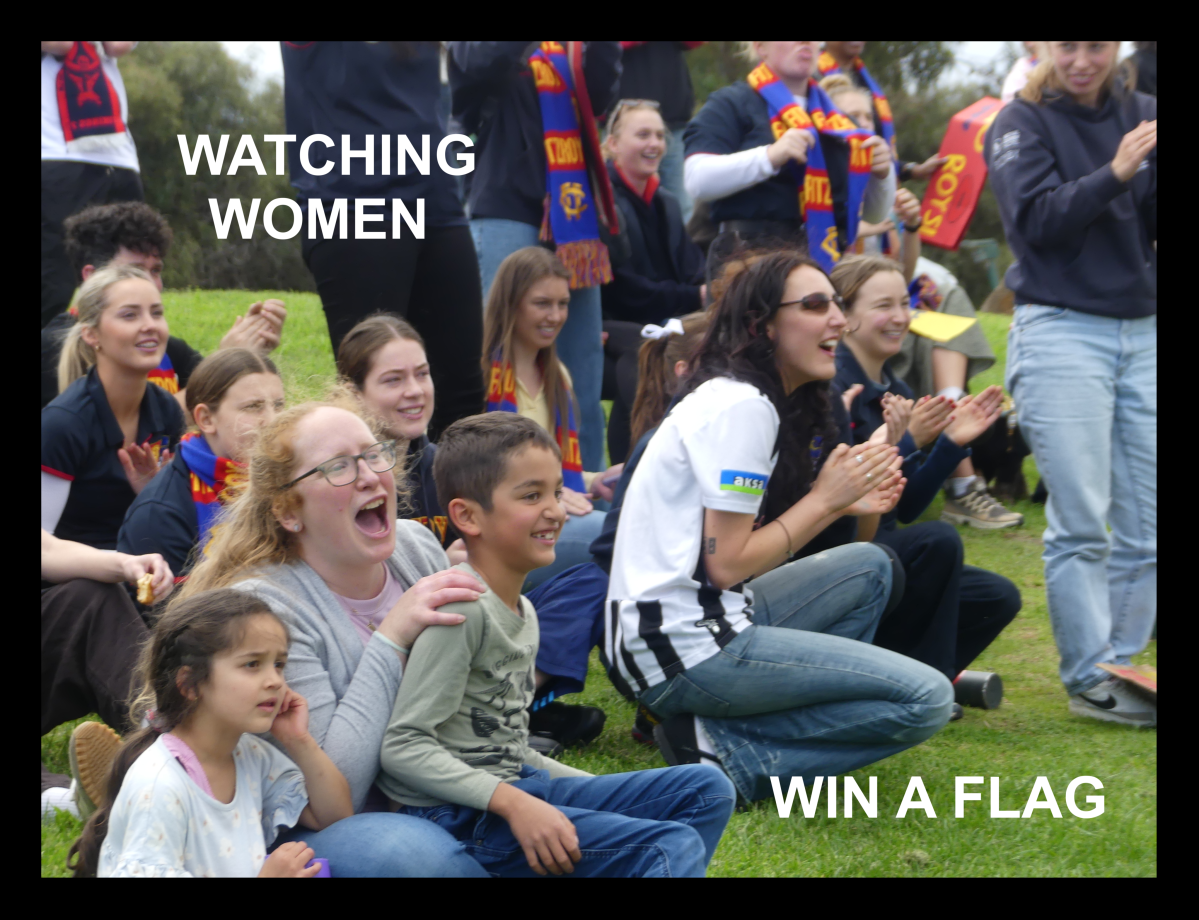
I love watching fast skillful free flowing football, especially the rapidly rising female Aussie Rules action.
I think that men and women should be treated as equal in everything except the three female spheres of activity of being pregnant, giving birth and breast feeding.
But I think that there are subtle differences in abilities and tendencies between men and women such as a slight tendency for women to be more empathetic than men.
Overall, empathy is also a very common quality in men, but, as a man who was a midwife for 30 years, my life experience has been to see a little more empathy in women than in men.
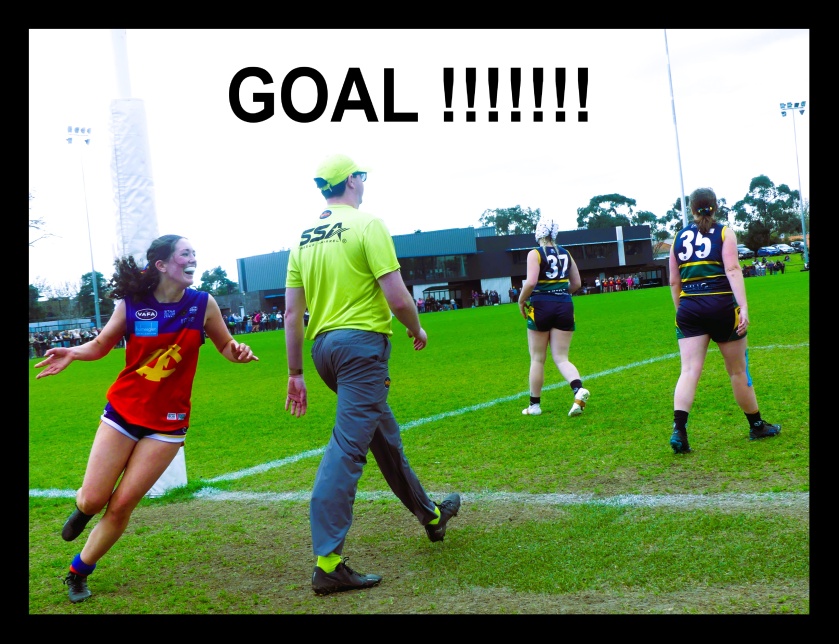
To me there is an emotional beauty in the way that the Fitzroy footballer pictured below celebrates a goal by a teammate in a grand final played last year that you wouldn’t see as often in a male player.
Women tend to be better at expressing this sort of joy than men are.
Our culture teaches men to hide emotions not to let them out.
Do women bring more joy to the game of football or is that joy gender neutral?
Is women’s football more fun?
I look forward to respectful and open discussion of my ideas with anyone anywhere who loves sport and the non-dogmatic pursuit of truth and fun.








 FOOTY FOR FREEDOM